
Tuesday, March 10, 2015

Day 1: A Day In the Life With Pictures of Dexcom G4 Platinum Share


Naturally Sweet Sisters
Dexcom Share - #CGMInTheCloud x2
We officially have one full day of #CGMInTheCloud under our belts.  As a family of four users with two parental "Followers" and two teen "Sharers", we mutually agreed it was fantastic!  Oldest daughter enjoyed her downplayed status of just 'checking' her iPhone while youngest daughter embraced it as a chance to share during an informal show and tell with teachers and classmates.  One grumpy text came through from oldest daughter as I politely asked for her to eat a snack.  We talked about it and I have a feeling we will talk about it as we go on.  I am NOT going to overshadow her desire for freedom but the truth is, sometimes it is safer.  We will find a balance and the good view is that we are each open with our needs.  That is half of the battle.

As a family, we also agreed that we need to make a few additional changes within each of their pump settings.  While we frequently download insulin pump data, we rarely extract CGM numbers. The rainbow mess of zig-zags can be difficult to decipher and slightly deceiving.  A smaller, shorter spike is not necessarily a reason to change as it could be simply a recalibration point.  In some cases, a spike occurs due to forgetting to pre-bolus, which again, is not cause for alarm.  There are also the times that CGM reflects what is naturally happening within our child; excitement, sadness, happiness or mad at parents!  Nah, that never happens, right?

In today's cloud observation, it was immediately clear that we had missed the mark on an I:C ratio for breakfast.  After our youngest daughter came home from school in the afternoon, it was discovered her steep breakfast increase had somehow changed to 9:30 am instead of 7:30 am. Youngest daughter thought she might have fat-fingered the time on Sunday while she was looking for the setting to change day-light savings time.  Understandable and because of our sharp eyes on the #CGMInTheCloud, we fixed the issue before it built up.  

The second situation was also one that occurred at school.  Oldest daughter negotiated a lighter breakfast to include only milk with chai tea.  Her junior high lunch hour is at 10:40 am, a time when many people are still digesting breakfast. We agreed that a light breakfast was fine, followed by her early lunch.  Our only stipulation was that an early afternoon snack had to be added.  Immediately upon entering school, oldest daughter was on the lower side of BG.  We opted to slightly adjust her basal rate and asked that she add in a small bit of protein to her meal.  Asking around the DOC, we found a few suggestions, one of which was to try a pre-package Chai drink that had 14 grams of protein.  After school, we went to our grocery store and picked it up.  Bonus? She loved it and agreed to try it tomorrow. 

To illustrate our new discoveries, here is our 24-hour day in pictures.


Monday Night at 11:16 p.m. - It works!!!


Tuesday When Everyone Else Is Sleeping at 12:31 a.m.  - One kid is immediately inducted into the 100 mg/dl club!!!


Tuesday Morning's Recovery from a Low and Watching a High on Tuesday Morning at 8:57 a.m. - Oh man.  Need some changes. Forgot to capture the earlier picture of oldest daughter at 70 mg/dl and arriving at school with Chai Latte.  Thinking this little bit of carbs is not going to hold her.  Sigh.
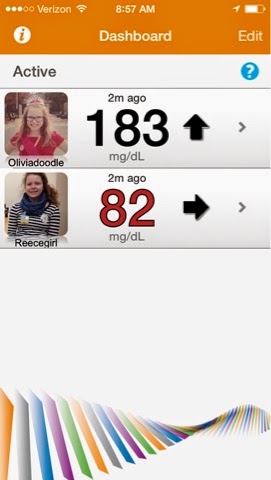


Tuesday LunchTime For Oldest at 10:29 a.m. - Oldest daughter heads to lunch and I resist the urge to text.  Meanwhile, staring at the 298 mg/dl and wondering why... morning ritual is to wake youngest daughter, check her blood sugar while she lays in bed and pre-bolus before her feet touch the carpet.  Makes no sense at all.  Sitting on my hands and hoping she gets to the correction.  


Lunchtime for Youngest Daughter Tuesday Morning at 11:30 a.m. - Youngest daughter heading off to lunch shortly and I know she will make the correction simply because this is the first time that I have witnessed a high like this.  By the time she comes home from school, numbers are perfect again.  


Tuesday Afternoon at 1:48 - Youngest daughter disappears from the radar.  Suspecting that she didn't have a full charge on her iPhone before she went to school.  In my excitement, forgot to move charger into her bedroom.  Old rule was cell phones not allowed in rooms at night.  New rule is cell phones allowed in room at night so mom and dad can see their follower app.  Parenting mind melt... now to hope neither girl fools around on phone late at night.  


Tuesday Afterschool for Oldest Daughter and resulting text from number dropping into 70s at 3:18 p.m. - She's a bit grumpy because I text during her afterschool yearbook club which is also a social hour.  I get it; #TeenT1d.  We discuss boundaries later and apply a few rules to the situation.  Mom won't text as long as number starts to go back up within 30 minutes.  Daughter won't wait to eat or reduce basal rate to avoid mom from texting.  Seems like a fair trade.


Afterschool for Youngest Daughter on Tuesday at 4:20 p.m. - Yes, my phone died.  


Tuesday night, post dinner at 7:07 p.m. - Both girls working on homework and no one wants to talk about T1d.  All earlier blood glucose settings changes have been entered into their insulin pumps.  I discreetly check and love the numbers.  Silently high five myself.  


Evening hour and bedtime close by at 8:44 p.m. on Tuesday -  Again, silent stealth like APP check and laugh... my twins.  Never fails.  #Naturallysweetsisters 


Check back again tomorrow as we further review our Dexcom Share and provide insight on a multi-user family!  


Monday, March 9, 2015

Unboxing Video - Naturally Sweet Sisters Part 1 and Part 2 Dexcom G4 Platinum Share


On Friday, through the awesome help of a triage of people - Jeff from Solara, Melissa and Simon from Dexcom and ofcourse, the lovely fast transport of FedEx, the Naturally Sweet Sisters upgraded their Dexcom Platinum G4 receivers with the brand new, Dexcom Share enhanced receivers that work with a wireless bluetooth connection that is enabled to send data to an iPhone uploader.

For the unboxing, the girls wanted to take the lead and share their experience with our Naturally Sweet Sisters readers.  I prompted a bit but for the most part, this is their point of view.

Part 1 is first and the video is just about 3 minutes long.  


Part 2 is after their 2-hr calibration, a must-do when setting up the new receiver.


A reader did ask me if we received a brand-new transmitter.  The short answer is no.  This shipment includes the receiver and a brand-new charger.

We will keep you posted as to the girl's individual experiences as they try out the new technology.

If you would like to order your own Dexcom G4 Share, please head over to the Dexcom website.

Stay tuned for Part 3 - A Week Of Share at School!


A1c Want to Know - Report From 2013 With a Few Additonal Thoughts...

This is a Naturally Sweet Sisters repost from 2013.  

My feelings from the patient - caregiver perspective regarding the A1c hasn't changed since I wrote this article.  If anything, the new ADA guidelines requiring pediatric patients to adhere to astonishingly low values of 7.5 or less, has further underscored the need to use a different metric to measure patient compliance/success.  As a mom that diligently monitored blood glucose in toddlers (without an accurate CGM)  through teens (with an accurate CGM), I can testify hormones can/will thwart even the most carefully laid out T1d plans.  In the year since this article was written, without modifying her lifestyle, our oldest daughter's A1c has decreased to 7.2.  The difference?  She acheived what is most likely her adult height and her hormones have stabilized.  Conversely, my youngest daughter, just two years behind her sister in entering the peak of puberty, hormones are surging and over the past six months, she has grown about 4-5 inches, to match her sister's stature.  Her A1c is 7.8 and while we will attempt to combat it with multiple (and aggressive) pump setting changes, it will most likely increase a bit more before leveling off.  

Unfortunately through that narrow clinical perspective of an A1c score, the true success is missed.  My girls have missed zero days of school due to T1d, they stayed healthy through out the winter, in our 8 long years of T1d, they have never been through the ER and even more importantly, they haven't missed out on doing anything they wanted to do... which has included sleepovers, theater performances, field trips, concerts, movie nights with friends and even dances where mom did not have to chaperone.  

A slightly higher A1c is exchange for a mentally healthy and well-balanced child is a risk that I am willing to take. 


As a parent who is leery of over emphasizing the A1c (good or bad), I thought it might be interesting for you to know where my own two daughters fall into the scale of quarterly numbers.

Before I do, I want to clarify a few things.

As we all know, this is a variable number which is subject to change and does NOT account for much of LIFE.  I want to demystify the idea that raising kids with type 1 diabetes should mean that we are "regulated" and have numbers in the low 6's. 

Um, no.

There is no such thing as regulating a pancreas in a person living with type 1 diabetes.

Especially when that person is living in their own body (not yours) and is growing at the rate of 1-2 inches (sometimes even more) and gaining at least 1-2 pounds every three months.  Dare I even mention the P-word?  Oh my!

And did I explain that person is a child who is often being invited to birthday parties, holiday festivals and taste-testing their way through Costco? Heck, even the car wash dude passes out two lollipops to her just because she is cute?  You don't think she throws those away, do you?

If you think those are excuses, well they aren't.  But they are good examples of raising our kids with the idea of "kids first, diabetes second".

That "kids first, diabetes second" is a very important part of raising healthy minded (and bodied) children.  What we risk by strictly counting calories, limiting choices or creating the idea that food is BAD, is instead, raising a child who might choose to sneak food, have poor self-esteem and make uneducated choices in their own diabetes care as adults.

What we don't want to do is create "adults depressed, diabetes distressed."

We, as parents, want to create a healthy environment that teaches children to listen to their bodies, take care of it through good nutrition and lots of exercise - all while enjoying an occasional treat AND counting carbohydrates AND dosing insulin.

Well, than if you understand these nuances of life and are now sitting there and wondering if your child's A1c is good enough?  I am here to tell you that it is.  

What you are striving for is to connect with your child, foster an environment of caring, nurturing, teaching to continually educate you and your loved one living with type 1 diabetes.   Around here, we use the A1c as a guide to help remind us where we are headed and what we would like to try to do differently.

  • Perhaps it is focusing on bolusing 15 minutes before eating dinner.
  • Maybe it is to make sure our tween is entering her blood sugars (all of her blood sugars) back into the pump, so we have a better focus of what is happening.
  • Or perhaps, we are even seeing an A1c that is suspiciously too low and maybe we want to try to wear a CGM for the first time to catch some hidden blood sugars.

Whatever it is you use to do with the information, the A1c is simply a moving target to help remind you to take action in your own diabetic care.  

What the A1c is not:
  • A Gold Star
  • A Validation for Parent of the Year
  • A Scarlett Letter
  • Or anything to be used to judge a family or loved one whom is living with type 1 diabetes

I always find it sad to hear one parent bragging up an A1c or talking down another.  It makes me wonder how their endocrinologist is teaching the family too.  Do they get a positive praise for only so-called good A1c's and sharply reprimanded for bad ones?  

I hope not.  

An A1c is what it is and you can guarantee that it will change several times (probably too many to count) during the time we have until a CURE.  Until then, if you see someone struggling or wondering if the have a good enough A1c, give them a hug and remind them of all the work and love that they put into their child's care.  And yes, it is most definitely good enough!

Youngest daughter, age 9:  7.8 HbA1c
 
Oldest daighter, age 11:  8.2 HbA1c